Can't think of a better way to end October, celebrating both Halloween and the close of Breast Cancer Awareness month, than this:
Wednesday, October 31, 2012
Happy Halloween
We lost power for about a day, thanks to Sandy, but we're up and running again and getting ready for Halloween.
Can't think of a better way to end October, celebrating both Halloween and the close of Breast Cancer Awareness month, than this:
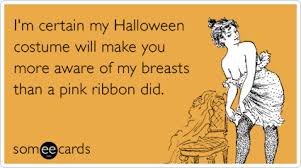
Can't think of a better way to end October, celebrating both Halloween and the close of Breast Cancer Awareness month, than this:

Sunday, October 28, 2012
Lance -- The Last Time, Probably
OK, one more post about Lance Armstrong.
I'll be honest -- I want to be able to defend him.
Doping is wrong, always has been, always will be, and it doesn't matter if everyone else did it. But he helped a lot of people. And I hope he and his foundation continue to help a lot of people. Will that be possible now? Will he be less of an inspiration to cancer patients?
I don't know. Two articles I read today complicate this. The first from Grantland, titled "Legends of the Fall." The subtitle is more relevant: "Lance Armstrong: A Liar, a Cheater, and an Inspiration." It gets into the complications of this situation. Lance was an inspiration, and an unlikely one, given how few people actually care about bike racing. But his story became legendary, and his winning became necessary to keep the story going. And the story became necessary to help the people he wanted to help. It's all kind of complicated; read the story to see how. It's not as simple as I'm making it.
The other piece was from the New Republic, and it's called "Keep Rooting for Lance Armstrong." This is not as straightforwardly rah-rah as the title suggests. It's about how Lance was an inspiration for a cancer patient, and his mixed feelings about Lance (leaning toward the positive) and anti-doping crusaders (leaning heavily toward the negative).
I think all of this will fade away soon enough. It will be interesting to see how his foundation manages without him -- not without him as its chairperson, but without him as its symbol.
I think about how cancer organizations have taken such a big hit this year: Komen, the ACS, Livestrong. And maybe that's the lesson for how to view Lance: we assume (or want to believe) that anyone or anything associated with helping cancer patients has to be genuinely good, whether it's a person or an organization. And it hurts twice as much to find out that people working for a good cause can do bad things, either in the name of the cause or somewhere off to the side. And it sucks to find that out, so it's easy to push it away and not believe it.
So I'm not going to devote too much energy to it. I've stowed away the lawn furniture and stocked up on jugs of water, and I'll wait out Sandy with my fellow East Coasters. More later, when the storm has passed.
Stay safe everyone.
I'll be honest -- I want to be able to defend him.
Doping is wrong, always has been, always will be, and it doesn't matter if everyone else did it. But he helped a lot of people. And I hope he and his foundation continue to help a lot of people. Will that be possible now? Will he be less of an inspiration to cancer patients?
I don't know. Two articles I read today complicate this. The first from Grantland, titled "Legends of the Fall." The subtitle is more relevant: "Lance Armstrong: A Liar, a Cheater, and an Inspiration." It gets into the complications of this situation. Lance was an inspiration, and an unlikely one, given how few people actually care about bike racing. But his story became legendary, and his winning became necessary to keep the story going. And the story became necessary to help the people he wanted to help. It's all kind of complicated; read the story to see how. It's not as simple as I'm making it.
The other piece was from the New Republic, and it's called "Keep Rooting for Lance Armstrong." This is not as straightforwardly rah-rah as the title suggests. It's about how Lance was an inspiration for a cancer patient, and his mixed feelings about Lance (leaning toward the positive) and anti-doping crusaders (leaning heavily toward the negative).
I think all of this will fade away soon enough. It will be interesting to see how his foundation manages without him -- not without him as its chairperson, but without him as its symbol.
I think about how cancer organizations have taken such a big hit this year: Komen, the ACS, Livestrong. And maybe that's the lesson for how to view Lance: we assume (or want to believe) that anyone or anything associated with helping cancer patients has to be genuinely good, whether it's a person or an organization. And it hurts twice as much to find out that people working for a good cause can do bad things, either in the name of the cause or somewhere off to the side. And it sucks to find that out, so it's easy to push it away and not believe it.
So I'm not going to devote too much energy to it. I've stowed away the lawn furniture and stocked up on jugs of water, and I'll wait out Sandy with my fellow East Coasters. More later, when the storm has passed.
Stay safe everyone.
Thursday, October 25, 2012
Health
I ran this morning. My asthma has been acting up, and I have a little foot pain for a few minutes until I've warmed up, and then I'm OK. Still, I went a little harder than usual today; I'm anticipating having to work off some fun-sized Almond Joys next week. Just two or three of them. Maybe 15. Hard to say. My wife has been wise enough to hold off on buying Halloween candy until the last possible minute, lest we have a repeat of the Mystery of the Disappearing Milky Way Darks of 2004.
So now, with that little bit of an extra effort this morning, I'm tired and my legs hurt. And I ask myself, is this really worth it? And I see exactly what I don't need to see at a time like this -- a time when I don't want to get off the couch, a time when there are special orange creme-filled Halloween Oreos in my kitchen. I see an article that says a large federal study of obesity has been cancelled after 11 years, because the results weren't what they expected.
What they expected was that all of the people with type 2 diabetes in the study would gain health benefits from all of that smart eating and exercising that they were doing. Instead, they found that there was no benefit. No decrease in heart attacks. No decrease in strokes.
It's enough to make me want to get a big glass of milk and say farewell to an entire sleeve of orange-creme-colored Oreos -- and all the ghosts, witches, and jack-o-lanterns on the 5 special Halloween themed cookie designs.
But I won't. Because I know exercise is good for cancer patients, especially those who are going through treatment. It helps us physically, even giving us a little more energy. It helps stave off muscle and bone loss. It might even curb nausea.
And it especially helps us mentally. It elevates our moods. It changes our perspective. It gives us a sense of control. It helps us develop perseverance.
So I will not get additional exercise today by doing a pull up off the couch and a spring to the Oreos. I will continue to run three days a week. I will be good today.
Today. But no promises for next week.
So now, with that little bit of an extra effort this morning, I'm tired and my legs hurt. And I ask myself, is this really worth it? And I see exactly what I don't need to see at a time like this -- a time when I don't want to get off the couch, a time when there are special orange creme-filled Halloween Oreos in my kitchen. I see an article that says a large federal study of obesity has been cancelled after 11 years, because the results weren't what they expected.
What they expected was that all of the people with type 2 diabetes in the study would gain health benefits from all of that smart eating and exercising that they were doing. Instead, they found that there was no benefit. No decrease in heart attacks. No decrease in strokes.
It's enough to make me want to get a big glass of milk and say farewell to an entire sleeve of orange-creme-colored Oreos -- and all the ghosts, witches, and jack-o-lanterns on the 5 special Halloween themed cookie designs.
But I won't. Because I know exercise is good for cancer patients, especially those who are going through treatment. It helps us physically, even giving us a little more energy. It helps stave off muscle and bone loss. It might even curb nausea.
And it especially helps us mentally. It elevates our moods. It changes our perspective. It gives us a sense of control. It helps us develop perseverance.
So I will not get additional exercise today by doing a pull up off the couch and a spring to the Oreos. I will continue to run three days a week. I will be good today.
Today. But no promises for next week.
Monday, October 22, 2012
Flu Shot
Interesting discussion in the support group today: should Follicular NHL patients get a flu shot?
We had some mixed responses, with some saying they were encouraged to get one, some saying they were discouraged, and some saying they were told not to, but were encouraged to tell everyone around them to get one.
For the record, I was told to get one when I was first diagnosed and visited the lymphoma specialist. It was January, at the height of flu season, and I hadn't had one yet.
But someone posted a link to a very recent article (published about a week ago) in the Journal of Clinical Immunology called "Rituximab-Treated Patients Have a Poor Response to Influenza Vaccination." The authors of the article seem to be specialists in Rheumatology, and Rituxan is used to treat disorders other than NHL, including rheumatoid arthritis. The authors examined 17 patients with rheumatology issues that had been given Rituxan and then a flu shot, and found that, as the title suggests, the response to the shot was poor. Only 16% had a four-fold increase in titer; this means that not many had a build up of the antibodies that are necessary to fight of influenza. This is the whole point of a flu shot: the body learns to recognize an invader and begins to develop antibodies that will fight it off when the real flu bug invades it.
The problem? Rituxan kills off the B cells that do all that fighting.
So it makes sense: give Rituxan; it kills bad B cells; it kills off good B cells; those cells can't do their job.
There was some speculation in the support group that maybe doctors were advising against a flu shot because those patients had been given Rituxan within the last 6 months, which is about how long it continues to work after the final dose. The authors of this study did find that there is some correlation between B cell recovery after Rituxan and success of the vaccine.
More time since Rituxan = more B cells = greater chance of success.
It all makes sense, but it's nice to have some evidence to back it up.
The takeaway? Get a flu shot. Unless you received Rituxan very recently, there's at least a chance that it will do some good. At the very least, it can't hurt.
And tell your loved ones to get flu shots, too.
We had some mixed responses, with some saying they were encouraged to get one, some saying they were discouraged, and some saying they were told not to, but were encouraged to tell everyone around them to get one.
For the record, I was told to get one when I was first diagnosed and visited the lymphoma specialist. It was January, at the height of flu season, and I hadn't had one yet.
But someone posted a link to a very recent article (published about a week ago) in the Journal of Clinical Immunology called "Rituximab-Treated Patients Have a Poor Response to Influenza Vaccination." The authors of the article seem to be specialists in Rheumatology, and Rituxan is used to treat disorders other than NHL, including rheumatoid arthritis. The authors examined 17 patients with rheumatology issues that had been given Rituxan and then a flu shot, and found that, as the title suggests, the response to the shot was poor. Only 16% had a four-fold increase in titer; this means that not many had a build up of the antibodies that are necessary to fight of influenza. This is the whole point of a flu shot: the body learns to recognize an invader and begins to develop antibodies that will fight it off when the real flu bug invades it.
The problem? Rituxan kills off the B cells that do all that fighting.
So it makes sense: give Rituxan; it kills bad B cells; it kills off good B cells; those cells can't do their job.
There was some speculation in the support group that maybe doctors were advising against a flu shot because those patients had been given Rituxan within the last 6 months, which is about how long it continues to work after the final dose. The authors of this study did find that there is some correlation between B cell recovery after Rituxan and success of the vaccine.
More time since Rituxan = more B cells = greater chance of success.
It all makes sense, but it's nice to have some evidence to back it up.
The takeaway? Get a flu shot. Unless you received Rituxan very recently, there's at least a chance that it will do some good. At the very least, it can't hurt.
And tell your loved ones to get flu shots, too.
Saturday, October 20, 2012
Quality of Life
This is just an abstract or summary from an article, not the whole thing, but even a para graph says a lot.
Ethan Basch from Sloan-Kettering is the lead author on "Recommendations for Incorporating Patient-Reported Outcomes Into Clinical Comparative Effectiveness Research in Adult Oncology," published in the most recent Journal of Clinical Oncology.
"Patient-Reported Outcomes" are what they seem -- what the patient says the effects of a treatment are, in addition to more "objective" measures.
The article is recommending that these Patient-Reported Outcomes be included when results are reported for clinical trials. So while it's easy to report that a certain percentage of patients in a trial had a partial or complete response, and it's easy to report on certain side effects like hair loss, the authors of this article recommend that we try to do something harder: report on how individual patient's quality of life are affected.
That is indeed going to be hard, and among the nine key recommendations is "to assure that PRO measures used are valid, reliable, and sensitive in a comparable population"; in other words, to make sure that everyone is collecting the data in the same way, so things can be compared accurately.
Especially with patients with a disease like Follicular Lymphoma (but really, with any cancer), when you're faced with a choice between a bunch of different treatments, it would be nice to say "I'm interested in making this thing go away, but I still want to be able to go to work." A stem cell transplant might have better overall survival numbers, but it might also knock you out of work for a while. On the other hand, Bendamustine might not last a slong, but it won't have you flat on your back for quite as long. (I don't have the numbers for those two treatments in front of me, so don't take that as a recommendation, just an example.) It would be nice to have more information than just "percentage of patients who had a response" when we have to make that kind of decision.
It's a small step, but a necessary one. It will be interesting to see how it is received, and if researchers are comfortable with including data that's a little fuzzier than they might be used to.
Ethan Basch from Sloan-Kettering is the lead author on "Recommendations for Incorporating Patient-Reported Outcomes Into Clinical Comparative Effectiveness Research in Adult Oncology," published in the most recent Journal of Clinical Oncology.
"Patient-Reported Outcomes" are what they seem -- what the patient says the effects of a treatment are, in addition to more "objective" measures.
The article is recommending that these Patient-Reported Outcomes be included when results are reported for clinical trials. So while it's easy to report that a certain percentage of patients in a trial had a partial or complete response, and it's easy to report on certain side effects like hair loss, the authors of this article recommend that we try to do something harder: report on how individual patient's quality of life are affected.
That is indeed going to be hard, and among the nine key recommendations is "to assure that PRO measures used are valid, reliable, and sensitive in a comparable population"; in other words, to make sure that everyone is collecting the data in the same way, so things can be compared accurately.
Especially with patients with a disease like Follicular Lymphoma (but really, with any cancer), when you're faced with a choice between a bunch of different treatments, it would be nice to say "I'm interested in making this thing go away, but I still want to be able to go to work." A stem cell transplant might have better overall survival numbers, but it might also knock you out of work for a while. On the other hand, Bendamustine might not last a slong, but it won't have you flat on your back for quite as long. (I don't have the numbers for those two treatments in front of me, so don't take that as a recommendation, just an example.) It would be nice to have more information than just "percentage of patients who had a response" when we have to make that kind of decision.
It's a small step, but a necessary one. It will be interesting to see how it is received, and if researchers are comfortable with including data that's a little fuzzier than they might be used to.
Thursday, October 18, 2012
Lance, Again
Well, it looks like it's over for Lance Armstrong.
The US Anti-Doping Agency released a 1000 page report last week, detailing all of the evidence against him. Lance resigned from his position as Chairperson of his Livestrong Foundation. Nike announced it was dropping their sponsorship; a bunch of others dropped him soon after the Nike announcement.
So, is this the end? Lance finally exposed as the cheat and liar that he is? Has he lost all the respect of the cancer community, now that he has had to drop the "cancer shield," as one writer put it -- that sympathy trump card he held because he was a survivor?
It's such a morally ambiguous situation, isn't it? You hate the cheater, but you love the survivor. You hate the liar, but you love the fundraiser. You ask if he could have ever raised the money he raised if he hadn't won, and you ask if he could have won had he never cheated. I don't know. I just don't know.
But I do know that there's been very little discussion of this issue in the last week among the cancer folks that I associate with online. When the accusations first came up weeks ago, I wrote here about the spirited defenses of Lance that cancer patients and survivors were putting up. The current silence might be interpreted as something like disgust, that people just don't want to admit that they were wrong in defending him. My guess, though, is that it's more that people are thinking that they said all there was to say, weeks ago, and they still support him.
As I've been reading others' reactions, trying to get a sense of where people stand, I came across an article by Ian Robertson called "Why Lance Armstrong is Still a Hero: 'Great Men are Almost Always Bad Men'." Robertson argues that any time you scrutinize someone's life, you find things that are bad. I think of Christopher Hitchens' well-known critique of Mother Teresa -- a hero to many, but a human being. I've often thought of how hard it would be to be named a saint in today's world, with so many more temptations, but also with so many more ways to be scrutinized.
And goodness knows Lance was no saint. Even apart from the cheating and lying, he was known to be a bully and an all-around jerk.
But, says Robertson, this is also a guy who stood up to testicular cancer that had spread to his lungs and brain. And then he got back on his bike and conquered mountains. Even if he hadn't won all those Tours, that would still all be pretty dang impressive, wouldn't it? That kind of courage is certainly worthy of admiration.
So that's where we are. A courageous man, but a flawed man. One who has ultimately done some good. And as a cancer patient, I hope he still, somehow, is able to do more good from here.
The US Anti-Doping Agency released a 1000 page report last week, detailing all of the evidence against him. Lance resigned from his position as Chairperson of his Livestrong Foundation. Nike announced it was dropping their sponsorship; a bunch of others dropped him soon after the Nike announcement.
So, is this the end? Lance finally exposed as the cheat and liar that he is? Has he lost all the respect of the cancer community, now that he has had to drop the "cancer shield," as one writer put it -- that sympathy trump card he held because he was a survivor?
It's such a morally ambiguous situation, isn't it? You hate the cheater, but you love the survivor. You hate the liar, but you love the fundraiser. You ask if he could have ever raised the money he raised if he hadn't won, and you ask if he could have won had he never cheated. I don't know. I just don't know.
But I do know that there's been very little discussion of this issue in the last week among the cancer folks that I associate with online. When the accusations first came up weeks ago, I wrote here about the spirited defenses of Lance that cancer patients and survivors were putting up. The current silence might be interpreted as something like disgust, that people just don't want to admit that they were wrong in defending him. My guess, though, is that it's more that people are thinking that they said all there was to say, weeks ago, and they still support him.
As I've been reading others' reactions, trying to get a sense of where people stand, I came across an article by Ian Robertson called "Why Lance Armstrong is Still a Hero: 'Great Men are Almost Always Bad Men'." Robertson argues that any time you scrutinize someone's life, you find things that are bad. I think of Christopher Hitchens' well-known critique of Mother Teresa -- a hero to many, but a human being. I've often thought of how hard it would be to be named a saint in today's world, with so many more temptations, but also with so many more ways to be scrutinized.
And goodness knows Lance was no saint. Even apart from the cheating and lying, he was known to be a bully and an all-around jerk.
But, says Robertson, this is also a guy who stood up to testicular cancer that had spread to his lungs and brain. And then he got back on his bike and conquered mountains. Even if he hadn't won all those Tours, that would still all be pretty dang impressive, wouldn't it? That kind of courage is certainly worthy of admiration.
So that's where we are. A courageous man, but a flawed man. One who has ultimately done some good. And as a cancer patient, I hope he still, somehow, is able to do more good from here.
Tuesday, October 16, 2012
Insipid Victory
I've been going back and forth about whether or not to comment on a story from the Atlantic from about a week ago, called "Lymphoma and the Insipid Victory." Someone sent me a link to it, and I read it, and it didn't hit me the way a When I Found Out I Had Cancer Story usually hits me. I blamed it on being kind of busy.
And then when some Lymphoma people starting discussing it on Facebook (I don't remember which group it was), I looked a little bit at their comments, which were negative, but it didn't really hit me what that had to do with my own reaction.
So I read it again. And I followed along OK -- Yes, the anger at being told, not directed at anyone, and then finally coming into focus when he saw his wife and baby. And then he finds out a little bit more about his cancer. He goes to Google, and finds out that Hodgkin's "usually hits males between the ages of 15 and 35 and over the age of 55." And he finds out that "its cause is maddeningly unknown. Maybe it was all the diet soda I drank or the road trip I took that one time to Three Mile Island, or the fact that I have a black cat that always walks in front of me when I'm on the treadmill." Ha. Funny.
Also, "It's a rare cancer, representing only one percent of all cancers in the U.S."
And he gets some good news. "Best of all, we learned that treatment for Hodgkin's lymphoma is pretty successful. According to American Cancer Institute statistics, the five-year survival rate is 85%, and ten-year is 81%. In researching, we also learned about non-Hodgkin's lymphoma, a related, but more serious and faster-acting cancer. I'd missed extremely bad news by three letters and a hyphen."
It was, upon re-reading, the NHL statement that bothered me. NHL is not "a" cancer, of course. And of its 30-60 different types (depending on who's doing the classifying), a whole bunch of them are not "faster-acting." As we all know. As for "more serious"? I don't know too many Hodgkin's patients who don't take their disease seriously.
And, in the end, that's what bothers me most. He really doesn't take this very seriously.
That's funny, maybe, coming from someone who spends a lot of time talking about how important it is for cancer patients to laugh at cancer. But that's not what I mean. He doesn't laugh at it, so much as kind of blow it off.
I get that a Google search isn't going to give you a whole lot of depth, especially about a disease that isn't your own. But the writer seems to be kind of willfully, maybe proudly, ignorant about his cancer. Which is fine when it's your own. I don't expect anyone to be as much of a Cancer Nerd as I am, and read the Journal of Clinical Oncology for fun. I know people, lots of people, who just don't want to know about their cancer, who want to put it in the hands of their doctor. (I have a friend with, ironically, Hodgkin's, who refused to even look at the bag of chemo when she was getting treatment.) And all that's fine. We deal with this thing whatever works for each of us.
But there's a difference between keeping it all to yourself and flaunting it in the Atlantic. "Flaunting" is probably a harsh word, but it bothers me when someone writing about cancer is uninformed. I don't think anyone would call Hodgkin's "rare." There are about 9000 new cases every year. Burkett's Lymphoma? That's rare. About 300 cases each year.
Is that being too picky? Maybe. But someone writing about cancer should have a better sense of what he's writing about, shouldn't he? Because when you're writing for the Atlantic, you're not just writing for yourself. You're writing for everyone who reads it, and you have a responsibility to get it right.
What upset people in the Facebook discussion most was this: "At no point, other than that one 45-minute car ride, was I looking death straight in its hollow eye sockets. My brush with it just wasn't bristly enough. Once it was discovered, cancer never really had a chance to kill me."
He means this to be praise for the current state of cancer treatment: science has come along enough, and his cancer was caught early enough, that even though the chemo made him feel "unrelievable agony. Nausea that wouldn't subside, aches that couldn't be soothed, weakness that wouldn't leave me." It's just a little too dismissive, especially taken with the other statements he makes. Because some people with Hodgkin's aren't so lucky.
And this sounds funny, too, but it's a good article. I can see it's purpose: maybe someone reads it and thinks, "yeah, I'll be OK too." And there's certainly a purpose for articles like that. I just wish it was less about the writer's cancer, and more about cancer.
The comments at the end of the kind of share my ambivalence. Some people really liked it, some really didn't. Just as we all handle our cancer our own way, we all get what we want out of what we read.
And then when some Lymphoma people starting discussing it on Facebook (I don't remember which group it was), I looked a little bit at their comments, which were negative, but it didn't really hit me what that had to do with my own reaction.
So I read it again. And I followed along OK -- Yes, the anger at being told, not directed at anyone, and then finally coming into focus when he saw his wife and baby. And then he finds out a little bit more about his cancer. He goes to Google, and finds out that Hodgkin's "usually hits males between the ages of 15 and 35 and over the age of 55." And he finds out that "its cause is maddeningly unknown. Maybe it was all the diet soda I drank or the road trip I took that one time to Three Mile Island, or the fact that I have a black cat that always walks in front of me when I'm on the treadmill." Ha. Funny.
Also, "It's a rare cancer, representing only one percent of all cancers in the U.S."
And he gets some good news. "Best of all, we learned that treatment for Hodgkin's lymphoma is pretty successful. According to American Cancer Institute statistics, the five-year survival rate is 85%, and ten-year is 81%. In researching, we also learned about non-Hodgkin's lymphoma, a related, but more serious and faster-acting cancer. I'd missed extremely bad news by three letters and a hyphen."
It was, upon re-reading, the NHL statement that bothered me. NHL is not "a" cancer, of course. And of its 30-60 different types (depending on who's doing the classifying), a whole bunch of them are not "faster-acting." As we all know. As for "more serious"? I don't know too many Hodgkin's patients who don't take their disease seriously.
And, in the end, that's what bothers me most. He really doesn't take this very seriously.
That's funny, maybe, coming from someone who spends a lot of time talking about how important it is for cancer patients to laugh at cancer. But that's not what I mean. He doesn't laugh at it, so much as kind of blow it off.
I get that a Google search isn't going to give you a whole lot of depth, especially about a disease that isn't your own. But the writer seems to be kind of willfully, maybe proudly, ignorant about his cancer. Which is fine when it's your own. I don't expect anyone to be as much of a Cancer Nerd as I am, and read the Journal of Clinical Oncology for fun. I know people, lots of people, who just don't want to know about their cancer, who want to put it in the hands of their doctor. (I have a friend with, ironically, Hodgkin's, who refused to even look at the bag of chemo when she was getting treatment.) And all that's fine. We deal with this thing whatever works for each of us.
But there's a difference between keeping it all to yourself and flaunting it in the Atlantic. "Flaunting" is probably a harsh word, but it bothers me when someone writing about cancer is uninformed. I don't think anyone would call Hodgkin's "rare." There are about 9000 new cases every year. Burkett's Lymphoma? That's rare. About 300 cases each year.
Is that being too picky? Maybe. But someone writing about cancer should have a better sense of what he's writing about, shouldn't he? Because when you're writing for the Atlantic, you're not just writing for yourself. You're writing for everyone who reads it, and you have a responsibility to get it right.
What upset people in the Facebook discussion most was this: "At no point, other than that one 45-minute car ride, was I looking death straight in its hollow eye sockets. My brush with it just wasn't bristly enough. Once it was discovered, cancer never really had a chance to kill me."
He means this to be praise for the current state of cancer treatment: science has come along enough, and his cancer was caught early enough, that even though the chemo made him feel "unrelievable agony. Nausea that wouldn't subside, aches that couldn't be soothed, weakness that wouldn't leave me." It's just a little too dismissive, especially taken with the other statements he makes. Because some people with Hodgkin's aren't so lucky.
And this sounds funny, too, but it's a good article. I can see it's purpose: maybe someone reads it and thinks, "yeah, I'll be OK too." And there's certainly a purpose for articles like that. I just wish it was less about the writer's cancer, and more about cancer.
The comments at the end of the kind of share my ambivalence. Some people really liked it, some really didn't. Just as we all handle our cancer our own way, we all get what we want out of what we read.
Subscribe to:
Posts (Atom)