Monday, August 8, 2016

Olympics Inspiration

This post is only a little bit about cancer.

I'm really enjoying the Rio Olympics. For all the fears of things that might happen (and that have happened) outside of the court/track/arena/pool, the athletic competitions have been pretty great so far. And the TV coverage has been kind of uneven, but the network has highlighted some great stories.

*********************

But before I get to that, I have to tell you about my favorite Olympian -- Mary Lou Retton.

Mary Lou won the individual all-around gold medal in gymnastics in 1984. She was the first non-Eastern European to win that gold. She was incredibly popular, not just because she was so great at her sport, but also because she always, always had a smile in her face.

Sometime in the mid-1990's, I got the chance to meet Mary Lou Retton, briefly. I don't remember the year, but I was living in Louisville, Kentucky, at the time, and my oldest child wasn't born yet. So I'll guess 1995 or so.

Mary Lou was on a promotional tour for Tyson Chicken at the time. She made an appearance at our local shopping mall. They had set up a kitchen in the middle of the mall, and  my wife and I sat in the audience. (My wife sat very reluctantly. She thought I had a crush on Mary Lou. Ridiculous. I only admired her athletic ability, and her positive spirit. The fact that she was cute as a button had nothing to do with it.) A small screen in the "kitchen" showed highlights of Mary Lou's career, and the film finished with her sticking a landing, her arms raised high. And then -- Mary Lou herself popped out, arms raised high!

She demonstrated a few recipes and talked about healthy eating.

Afterwards, we were given a small cookbook of chicken recipes from Tyson. Here's a picture; you can get it yourself  for $2.75:
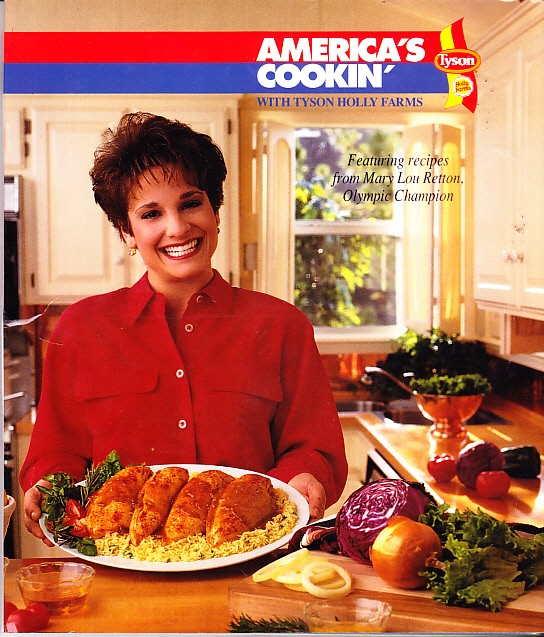


The Orange Chicken recipe is a Must Try!

We were also given the opportunity to get an autograph. Most people were polite and gave Mary lou their name, got their autographed picture, and moved on. That's what my wife did when she went ahead of me. But then she looked back and saw me taking a little extra time to chat with Mary Lou -- probably more than most people did. But I needed to tell her that I appreciated that she was always so happy, when some of those other young athletes just looked miserable. And I was glad she was seemed so happy then, too. She thanked me. My wife thought I was being creepy, but I was sincere. If you've read this blog for a while, you know how much I value someone who is positive.

And I got my autographed picture. It's in a safe place, and I don't want to take it out and copy it, so I'll show you someone else's autographed picture from that same Tyson Chicken promotional tour:


***********************************

I told you that so I can tell you about the most amazing athlete in the Rio Olympics, in my opinion: Oksana Chusovitina, who is a 41 year old gymnast.

41 years old!

Chusovitina was born in Uzbekistan, after the Soviet Union came apart, she competed in the 1992 Olympics for the Unified team, made up of former Soviet countries. Then she competed for Uzbekistan in 1996, 2000, and 2004. The  she moved to Germany and competed for them in 2008 and 2012. Now she's back at Rio, competing for Uzbekistan again. (That's 3 different teams.)

And did I mention she is 41 years old!

Know what I was doing at 41? I wasn't competing in Olympic gymnastics, that's for sure. Mostly, I was having cancer and eating ice cream.

She won a team gold medal at the 1992 Olympics, and a silver in the vault in 2008, when she was 33 years old. She's also had 5 moves named after her -- two on the vault, two on uneven bars, and one on floor.

And if you're looking for a blood cancer angle here, it is this: she moved to Germany because her son was diagnosed with leukemia. She paid for the treatment in part by winning gymnastics competitions.


I just can't over the fact that she can do the kind of things she can do at her age, especially when most of her competition is about as old as her 16 year old son. She's pretty inspirational, isn't she? If she can train every day for the Olympics at her age, surely the rest of us can get to the gym for a half hour, three days a week, and make ourselves healthier.

Back to Follicular Lymphoma next time.  But for now, I just have to admire this woman a little bit more.

Tuesday, August 2, 2016

Staging Lymphoma with PET Scans

ASCO Post has a great video featuring a discussion between Dr. Julie Vose and Dr. Bruce Cheson. (Of course I'm going to think it's great -- it features Dr. Bruce Cheson!) The discussion took place at the 2016 Pan Pacific Lymphoma Conference in Hawaii (which explains Dr. Cheson's great shirt, though I wouldn't be surprised if he wore a shirt like that all the time, just because it made him happy).

The video looks at how lymphoma is staged -- that is, how oncologists determine how widespread the disease is in the body. They look especially at how PET scans can play a role (or not play a role) in staging.

Scans have become more controversial over the last few years. There seems to be some agreement among oncologists that scans are a good idea for initial staging -- figuring out where the disease is in the body, to help determine the best course of treatment. There is much less agreement on how useful scans are after that point (though most oncologists see some value in a scan after treatment, as a way of measuring how well things went since that initial scan at diagnosis).

This doesn't even get into the problems with scans to begin with -- there's a lot of room for different people to administer and read scans in different ways, making them tough to compare.

(Lymphomation.com has some basic information about PET scans that is worth looking at if you need some background.)

 In the video, Dr. Cheson and Dr. Vose discuss some of the history of PET scans, as well as some of the other tests used before (including one that involved injecting blue dye between a patient's toes -- makes drinking those barium milkshakes seem like fun). It wasn't until about 2007 that PET scans became an expected part of staging (which is interesting to me, since I was diagnosed, and scanned, shortly after that).

Dr. Cheson mentions that CT scans with contrast don't do much better than CT scans without contrast, though the contrast ends up giving 50% more radiation to the patient, and is more expensive. there are some situations where contrast helps, but mostly it doesn't.

In addition, PET scans can replace Bone Marrow Biopsies in some lymphomas. (Unfortunately, Follicular Lymphoma isn't one of them -- we still need that BMB.)

Scans are most useful about 6-8 weeks after treatment, since it can take that long for inflammation to come down. This post-treatment scan is known as a "re-staging scan."

However, routine scans after that re-staging scan are discouraged. They rarely pick up that the disease has progressed. In fact, about 80% of the time, a patient is the first one to pick up a symptom and report it to the oncologist. Having a scan once a year is unlikely to find something before a patient notices some kind of change. Routine scans only add radiation to -- and subtract money from -- the patient.

All in all, a pretty interesting video, with some good reminders about when scans are useful, and why we shouldn't rely on them too much.

Plus -- that shirt!
 

Thursday, July 28, 2016

Immunotherapy in Follicular Lymphoma

Onc Live published one of their "Peer Exchanges" last week, this one focusing on "Immunotherapy in Advanced Lymphoid Malignancies." The four experts discuss several types of immunotherapy, and several types of blood cancers, including Follicular Lymphoma. There are two videos, about 6-7 minutes each.

The first video is called "Immunotherapy: What is the Role in Lymphoid Cancers?" and, as the title suggests, it gives some basics about Immunotherapy and how it is being used in fighting blood cancers.

Immunotherapy is a general term for cancer treatments that use the body's own immune system to fight the cancer. Rituxan, which has done so many great things for Follicular Lymphoma patients for nearly 20 years, is an Immunotherapy -- it attracts parts of the immune system to the cancer cell, which then kill the cell. More recent Immunotherapy treatments target other things, and have been very successful for a number of cancers. The first video discusses some particulat treatments that have been effective for melanoma.

The second video is called "Immunotherapy Response Among Hematologic Malignancies," and focuses more on blood cancers.

The panelists point out that "these are early days" for Immunotherapy for blood cancers -- work on solid tumors has been going on a little longer. But there has been some interesting work in turning off the mechanism that allows cancer to grow unchecked, in several blood cancers, including Follicular Lymphoma.

This year's ASCO conference featured many Immunotherapy sessions, with some early but exciting data that showed a lot of promise for FL. Much of the work to be done now is focusing on finding biomarkers -- genetic signals that will help predict which treatments will be most effective before they are given.

It's an interesting 13 minutes of discussion from some very smart folks.

Immunotherapy: What is the Role in Lymphoid Cancers? - See more at: http://www.onclive.com/peer-exchange/lymphoid-malignancies/immunotherapy-whats-the-role-in-lymphoid-cancers#sthash.j2fNiBSn.dpuf

Friday, July 22, 2016

Follicular Lymphoma Risk Model

This isn't "new," exactly, but it's kind of "official" now.

At the ASH conference last December, some researchers looked at what is now called the "m7-FLIPI" model, and what it means for clinical oncologists -- the good folks we see when we have an oncologist appointment. 

That research has been written up and published in the journal Blood, in the article "Clinicogenetic Risk Models Predict Early Progression of Follicular Lymphoma After First-Line Immunochemotherapy." That means it has now been peer-reviewed -- looked over by other experts -- and seen as good enough research to be accepted by all.

So what does the article say?

Well, they begin with the idea of POD24 -- Progression of Disease within 24 months after treatment. Researchers have found that POD24 is a good predictor of Overall Survival. That is, if a patient has had immunochemotherapy (Rituxan + Chemo), and then has the disease return (if there was a Complete Response) or get worse (if there was a Partial Response) within 24 months, then there is a good chance that their FL is more aggressive than the usual indolent version. It's not transformation, but something else -- maybe an entirely different type of FL.

The researchers has hoped that the m7-FLIPI model would help them identify that group (which could make up about 20% of Follicular Lymphoma patients). FLIPI indexes are often used in clinical trials to make sure the group of patients in the trial are roughly the same. They look at factors like age, number of lymph node areas involved, etc. to come up with a very general assessment of risk. In other words, a high or low FLIPI score means nothing for an individual patient -- it doesn't predict how long you will live or whether a particular treatment will work for you.

last summer, some researchers proposed the m7-FLIPI model. This takes the standard (and, again, very general) FLIPI model and adds seven gene mutations (EZH2, ARID1A, EP300, FOXO1, MEF2B, CREBBP, and CARD11, if you're interested in knowing), and looks at all of these factors to determine how likely someone is to have this potentially more aggressive version of FL.

The m7-FLIPI has the potential to be more accurate because it is (as the article title puts it) "clinicogenetic." It combines the clinical factors that an oncologist can see (age, stage, LDH level, etc.) with genetic factors that can be seen only through analysis of a patient's genes.

In the article, the researchers looked at two groups of patients and found that the m7-FLIPI did the best job of predicting POD24 -- patients who had problems within 2 years of having immunochemotherapy.

The m7-FLIPI isn't a perfect predictor, however. The researchers recommend more work be done to identify this group of 20% much earlier, so that initial treatment strategies can be developed before that 24 month period.

So how does this affect all of us? At the moment, it might affect those of us who do fall into that POD24 group. More aggressive treatment might be necessary than was thought a while ago.

But as far as our every day lives go, I'm going to recommend that nobody panic, especially if you were diagnosed recently, or had immunochemotherapy less than 2 years ago. The models are not perfect, and no model can predict our individual diseases -- not yet, anyway.

As always, I recommend you live your life as "normally" as a cancer patient can. Hug your loved ones a little more often and little bit longer. Make your small part of the world a little bit better. And if and when the time comes, be informed enough to be able to talk to your doctor in a way that lets you understand what she tells you, and that lets you ask the questions that you need answered.


Saturday, July 16, 2016

Rituxan Maintenance (It's Back)

Follicular Lymphoma, as most of us know, is a cancer with few answers. There are lots of questions (like the basic, "Which treatment is the best one?"), but 12 oncologists will give you 13 different answers. (I stole that line from Dr. C, the lymphoma specialist I saw years ago.)

Rituxan Maintenance is one of these FL-related issues with more questions than answers. There are a bunch of studies that have been done since I have started paying attention to these things, and they seem to go back and forth -- one will have evidence that RM is a good thing, and then another will say it's more bad than good. And still another will say is does some good, but it isn't necessary.

So it's hard to know what to make of Rituxan Maintenance. (And if you need a reminder of what it is and how it works -- and more detail on the controversies of whether it's worth doing -- here's Lymphomation's take.)

The most recent addition to the long conversation about Rituxan Maintenance comes from the journal Cancer, in an article called "Randomized phase 3 study in low-grade lymphoma comparing maintenance anti-CD20 antibody with observation after induction therapy: A trial of the ECOG-ACRIN Cancer Research Group (E1496)."

The study is a follow-up on a trial from the ECOG-ACRIN research group, which actually began the trial long ago (the fact that patients in the trial were given CVP chemotherapy is kind of a clue for me that this trial started long ago). Their initial finding was that Rituxan Maintenance increased Progression-Free Survival -- the time it takes from treatment until the disease comes back again. So patients who had RM went longer before another treatment than patients who just had the chemo and then observed.

For this study, several years later, they wanted to see if that benefit held up, and if any other benefits (like increased Overall Survival) came through.

So after receiving CVP chemo, 158 patients were given RM (Rituxan once a week for 6 months), and 153 were just observed. After a median of 11.5 years, they found that the Progression-Free Survival benenfit remained: RM patients went almost 5 years before needing treatment, while patients without went 1.3 years (that's a median time for both).

However, there was no difference in Overall Survival between the two groups. So Maintenance might give you a few years before you need another treatment, but you will live the same amount of time whether you get RM or not. This is pretty much in line with other Rituxan Maintenance studies, which find some benefit, but not an OS benefit -- at least not one that's great enough to say Maintenance is a good idea for everyone.

I like their conclusion, that RM "should be considered optional" for patients with indolent lymphoma.  There is some benefit, obviously, and someone who wants to hold of on another treatment within a couple of years might consider it.

As I have said before, studies about Rituxan Maintenance don't really give us answers. It seems like, if we wait a year or so, some other study is going to tell us something that might say the opposite of this.

I'll be very interested when, in a few years, we have enough of an understanding of Follicular Lymphoma biomarkers that we can look at a genetic sample and say with a little more likelihood that some patients will benefit from maintenance and some won't get much out of it.

I'm confident that we'll get to that point sometime soon. Until then? "Optional."

(At least until the next study that tells us that we should all do it.........)

Monday, July 11, 2016

We are Changed by Cancer and Time

Last night, I watched the movie Rent. I hadn't seen it in a long time, and my musical theater-loving kids wanted to watch it.

Rent the movie is based on Rent the stage musical. It holds a place in my heart because my wife and I saw the stage musical about 10 days after I was diagnosed with cancer. I had bought her tickets for Christmas, and I remember we had thought about not going, but we decided the distraction would be good for both of us.

It's actually a really great show, but I had a hard time with it back then. If you aren't familiar with it, it's about a year in the life of a group of friends in 1989/1990 in New York. It's based on Pucchini's opera La Boheme. For the most part, the characters are artists of some type, trying to stay true to themselves while also dealing with relationships that are complicated by the AIDS crisis that was close to its peak at that time. It was a ground-breaking musical with lots of great songs.

But when my wife and I saw the show back then, just after I was diagnosed, the thing that struck me most was how how messed up the characters' priorities were. This is what I wrote in the blog way back then (January 28, 2008, if you want to look it up):

I think, though, that if I had seen it when it first came out, I would have been at an age to appreciate it more. The bohemian, anti-establishment message was a little lost on me. I found myself thinking, "You're cold because your landlord padlocked your building because you haven't paid your rent in a year, and now you're squatting in your old apartment? I have a good idea -- get a job."

I wasn't in a good place then.

But what struck me last night, watching the movie version 8 1/2 years later, is how much I had missed. Stuff I couldn't really have seen, not that soon into my dealing with cancer.

What really struck me last night, almost immediately, wasn't that they were a bunch of kids who didn't want to get jobs. What struck me was how much they relied on each other.

There are a few scenes in the movie involving an AIDS support group (four of the eight main characters have AIDS or are HIV positive). I could never have known, 10 days into my own diagnosis, how much a support group means to someone who is hanging on to hope so desperately. I was still numb when I saw the stage show. Desperation was still a few days away.

It's amazing to think about how much I missed that desperation. AIDS isn't cancer, and I can't say I know how someone with AIDS feels, and my own cancer isn't the death sentence that AIDS was in 1989. But it felt like it at times, early on. In one of the support group scenes, the members stand in a circle and sing about their fears:

Will I lose my dignity
Will someone care
Will I wake tomorrow
From this nightmare?


It's a heartbreaking scene. They know they are helpless in stopping their disease from getting worse. And even worse, it's a slow decline that they have probably seen in their friends.

If I had seen this show a month later, I think I would have focused on the fear, more than anything. I don't think it would have been that specific a fear, about dying with dignity. But I do remember feeling that there was nothing I could do to stop it from coming. I remember thinking, early on, how messed up it was that I pretty much knew how I was going to die. I wouldn't even have the luxury of being surprised.

But I didn't focus on that. I focused on how small some of the characters' problems were -- paying rent while staying true to themselves.

And it all made me think about how much has changed since I was diagnosed.

That reaction really sums things up for my early life as a cancer patient. I was the impatient patient. Maybe because watching and waiting requires so much energy to NOT think about cancer, I was impatient in everything else in life. I'm generally a laid back person, but back then, I just couldn't stand the idea of people wasting time on things that didn't matter. Work was hell sometimes, because I work in a field where we have to spend a lot of time talking about things in a very small detailed way. And some things really do require that kind of detail. But somethings don't. And I would lose my mind sitting in meetings when I could have been doing other things.

I remember, in the months after I was diagnosed, getting pulled over by a police officer for talking on my cell phone while driving, which is illegal in my state. But I WASN'T on my phone. I think I was just leaning on my hand, waiting for the light to change, and from behind, it looked like I was holding a phone to my ear. And I argued with the police officer, which was justified, but very unlike me. As I said, I'm usually very laid back, and respectful of authority. But that post-diagnosis impatience was in full swing, and I wasn't tolerating anyone who wasted my time.

And over time, that changed. I'm back to being patient and laid back, at least most of the time.

So when I watched Rent last night, it wasn't impatience that came out. It was mercy.

That's the word that came to me. Mercy.

I think much less about myself and the way I want the world to be for me. I think I'm more likely now to see others' suffering and want to help. Or at least to identify with it and feel bad.

Cancer changes us. Probably in lots of ways, over time. I think that's especially important for those of us who have more time to live with it than we might have thought at first.

I don't want the message here to be that cancer makes us better people. I'm not sure it does, and I don't think it should. I'm not someone who sees cancer as a gift. And I'm not someone who thinks we need to be positive all the damn time. Cancer didn't make me a better person, at least at first. It made impatient and selfish -- someone who sees people dying on stage and wishes they'd stop whining and get jobs. Cancer made me a jerk.

But things change over time. And if I got anything out of Rent this time around, it was that, even as people carry their own burdens, sometimes they are able to see the pain in others, and do something to make the world (or just their small piece of it) a better place.

I like that message a whole lot more.


Tuesday, July 5, 2016

Understanding Transformed FL

Two articles from The Journal of Clinical Oncology on Transformation in Follicular Lymphoma. The first, "Risk Factors and Outcomes for Patients With Follicular Lymphoma Who Had Histologic Transformation After Response to First-Line Immunochemotherapy in the PRIMA Trial,"describes the results from a large study of FL patients. The second, "Will a Better Understanding of the Problem With Transformed Follicular Lymphoma Lead to Better Outcomes?" is a commentary on the first article. They both have some interesting things to tell us.

The research article is the latest in a bunch of studies that are trying to understand Transformation a little bit better. There's still a whole lot we don't know about transformation, even basic stuff like why it happens. We know what happens, but we don't know enough about why it happens to be able to predict it. It's always kind of sad surprise when it happens. And a study seems to suggest something about Transformation, but then other studies contradict it, or can't confirm it strongly. It's frustrating, and partly why Transformation is such a scary thing.

The research article looked at over 1000 FL patients over 6 years. A few things that struck me as important:

They identified certain things as risk factors for Transformation. I'll say it again -- these are RISK FACTORS, not guarantees that Transformation is going to take place: altered performance status (I assume they mean a change in your ability to care for yourself, which is what "performace status" usually means), high LDH (Lactate Dehydrogenase, common in FL blood tests, it measues cell damage) “B” symptoms, a grade of 3a, and a high FLIPI score.

Again, those are RISK FACTORS -- it means you have to be a little more careful in keeping an eye out for symptoms. Patients with risk factors aren't guaranteed to transform, and patients without risk factors can also transform.

Like I said it's unpredictable, and that's what makes it scary.

The research article also suggests that an Autologous Stem Cell Transplant might be a good idea for transformed patients, and that a biopsy should be taken when the FL comes back after the first treatment, to be sure it hasn't transformed. (There are some other results, too -- worth looking at the link.)

The second article, the one that comments on the research article, is also interesting, but also a little frustrating in some of the things it says.

The article looks at the research article above, plus three other articles about Transformation, all published in the last 3 years. The author says that these four articles together tell us a lot about what we know about Transformation, and it's a lot that we didn't know before.

For example, in addition to confirming the risk factors from the research article above (high LDH, grade 3, and a high FLIPI), the studies also seem to agree on a transformation rate of 2% over the 10 years after diagnosis, or a 20% change of transforming (a lot lower than some estimates I have seen, though a little higher than others).

But the article also makes it clear that the four studies are hard to compare to one another, since they all look at slightly different groups of patients, and look for slightly different things. So while there are some common risk factors, I'm still a little hesitant to use stronger language than "risk factors." I think we're all on the look out for transformation (it is, as the article says, "the greatest fear of patients and their medical teams.") Interesting that they say it's a fear for the medical team, too -- I think that reflects the kind of frustration that our oncologists have in trying to predict where our disease will go, and then what they should do to treat it.

The article ends with a wish that we will someday soon have a better way to predict Transformation. It cites a few articles that have done some early identification of possible markers for Transformation, including IRF-4 (a gene that codes proteins), miR-31 (which helps suppress tumors, so having less of it is a bad thing), bcl-2 (which helps control cell death), pleuripotency (which describes cells that can develop into any cell in the body), and nuclear factor kappa B pathway genes (which helps cells divide normally). There is no strong proof that any of these things are responsible for Transformation, but there is some suggestion that they might play a part.

Maybe we'll find that there is a combination of these factors that work together to make Transformation happen? And then we'll be able to target those things with new treatments?

It would just be nice to know something, wouldn't it?

In the meantime, we seem to know a little bit more with every new study -- even if what we know is that we don't know as much as we wish we knew. The best thing we can do as patients is, I think, stay alert to changes in our selves, and try not to panic.

You know, the stuff we're used to doing anyway.