Another good one from ASCO: "Effect of bortezomib on complete remission (CR) rate when added to bendamustine-rituximab (BR) in previously untreated high-risk (HR) follicular lymphoma (FL): A randomized phase II trial of the ECOG-ACRIN Cancer Research Group (E2408)."
I've written about combination therapies before -- the idea that one single treatment probably isn't going to cure Follicular Lymphoma (or most types of cancer). Cancer is a sneaky thing, always finding ways around our attempts to stop it. So combinations that attack the cancer in different ways might have a better chance of stopping it.
And this ASCO piece is about as combination-y as you can get. It's almost like the researchers looked at every FL treatment that has work in the last 5 years and tried to find a way to work it in. It's one big FL-killing stew.
Basically, they added Velcade (Bortezomib) to the already-successful combination of Bendamustine and Rituxan. Then, for good measure, they added Lenalidomide (Revlimid) to Ritixan Maintenance (making R-Squared Maintenance). Like I said -- if something has worked in the last few years, they threw it in there.
The study looked at 222 untreated FL patients who were considered "high risk," with a high FLIP score or high tumor burden. They were divided into 3 groups: one was given Bendamustine + Rituxan (BR) and then Rituxan Maintenance (RM). The second had BR + Velcade, and then RM. The third got BR + Velcade, and then RM + Revlimid.
The Overall Response Rate (complete or partial response) for BR was 90%, and for BR + Velcade, it was 91%. Pretty much the same.
But the Complete Response rates were very different: BR was 58%, but BR + Velcade was 74%. That's a pretty amazing difference.The researchers called it "significantly superior."
No word on how the Revlimid affected things, though the conclusion does say that more follow-up is needed to determine whether the Revlimid helps with prologing that CR.
So I'd call this good news. There were certainly some side effects (that's the problem with combining so many treatments -- you combine all of the bad stuff that goes with it, too. And there's always at least some bad stuff).
But a 74% CR rate says something about how well that combination is cutting off cancer's escape routes. This might not be THE combination we're looking for, but if nothing else, it gives us more evidence that the general strategy of combining treatments holds a lot of promise, and we're going to keep seeing more of it in the future.
Thursday, June 9, 2016

Monday, June 6, 2016
ASCO: Vitamin D and Follicular Lymphoma
Here we go! ASCO research!
Before we get into this, it's worth reminding everyone of whet we're dealing with here. ASCO, the annual meeting of The American Society of Clinical Oncology, is a very important place for cancer researchers to present their findings to other oncologists. However, it is NOT the place where they present their final results. They may get feedback from other oncologists, and they may get people excited about their research, but it needs to go through a peer review process to really be trusted. That's when other experts in their field go through their results and give them a stamp of approval, so they can be published in a medical journal.
That's important to remember. We can get excited about ASCO stuff, but not officially excited.
*************************
Up first: "Association of Vitamin D Insufficiency with Inferior Prognosis in Follicular Lymphoma."
This research builds on work that was presented at ASCO in 2012, and then was eventually peer reviewed and published in the Journal of Clinical Oncology in 2015. In the earlier work, researchers found that low levels of Vitamin D in patients who had been given Rituxan + chemo resulted in lower Overall Survival. (Of course, that's a statistical analysis, and some patients did not have a lower OS.)
The research being reported on this year asks if low Vitamin D levels are a problem for ALL Follicular Lymphoma patients, no matter what treatments they've had, and not just the R + chemo patients. (It's a recognition that maybe it's the treatment that needs Vitamin D.)
They looked at 659 FL patients, hoping to predict whether low Vitamin D would be able to predict Event Free Survival at 12 Months (that is, they the patient went a year without the FL coming back or getting worse), Overall Survival, and Lymphoma-Specific Survival (that is, that their death was caused by their lymphoma).
They found that 34% of the patients had low Vitamin D levels, and of the 659 patients they looked at, there were 389 events (lymphoma returned or got worse), and 82 deaths (46 due to lymphoma).
For the whole group, low Vitamin D was associated with lower Event Free Survival, Overall Survival, and Lymphoma-Specific Survival.
This was also true for the specific patients who had Rituxan + Chemotherapy.
For patients who were on Watch and Wait, and who take treatments other than Rituxan or R + Chemo, low Vitamin D was associated with lower Overall Survival and Event-Free Survival.
Researchers could not make associations between Low Vitamin D and other treatment groups that were statistically significant.
Their conclusion is that, because there seems to be a connection between Overall Survival and low Vitamin D levels, this is something worth looking into.
Now, personally, I take a Vitamin D supplement every day. A few years ago, I had read enough to suggest that low Vitamin D might cause a bunch of problems, and since I don't stay out in the sun much, I could probably use the extra D. It's easy to find, costs me about $6 a month, and won't hurt if I take it in moderation (and with my doctor's permission).
That certainly doesn't mean that Vitamin D is the reason my lymphoma has stayed pretty stable. I just can't know that. I'm not one to believe in miracle cures, which is why I like seeing research like this. I will keep looking for their peer-reviewed follow-up, and any other research on this subject.
In the meantime, remember that any supplement should only be taken after talking with your doctor. Even Vitamin D has some potential complications for lymphoma patients.
But we can still be hopeful. More ASCO news soon.
Before we get into this, it's worth reminding everyone of whet we're dealing with here. ASCO, the annual meeting of The American Society of Clinical Oncology, is a very important place for cancer researchers to present their findings to other oncologists. However, it is NOT the place where they present their final results. They may get feedback from other oncologists, and they may get people excited about their research, but it needs to go through a peer review process to really be trusted. That's when other experts in their field go through their results and give them a stamp of approval, so they can be published in a medical journal.
That's important to remember. We can get excited about ASCO stuff, but not officially excited.
*************************
Up first: "Association of Vitamin D Insufficiency with Inferior Prognosis in Follicular Lymphoma."
This research builds on work that was presented at ASCO in 2012, and then was eventually peer reviewed and published in the Journal of Clinical Oncology in 2015. In the earlier work, researchers found that low levels of Vitamin D in patients who had been given Rituxan + chemo resulted in lower Overall Survival. (Of course, that's a statistical analysis, and some patients did not have a lower OS.)
The research being reported on this year asks if low Vitamin D levels are a problem for ALL Follicular Lymphoma patients, no matter what treatments they've had, and not just the R + chemo patients. (It's a recognition that maybe it's the treatment that needs Vitamin D.)
They looked at 659 FL patients, hoping to predict whether low Vitamin D would be able to predict Event Free Survival at 12 Months (that is, they the patient went a year without the FL coming back or getting worse), Overall Survival, and Lymphoma-Specific Survival (that is, that their death was caused by their lymphoma).
They found that 34% of the patients had low Vitamin D levels, and of the 659 patients they looked at, there were 389 events (lymphoma returned or got worse), and 82 deaths (46 due to lymphoma).
For the whole group, low Vitamin D was associated with lower Event Free Survival, Overall Survival, and Lymphoma-Specific Survival.
This was also true for the specific patients who had Rituxan + Chemotherapy.
For patients who were on Watch and Wait, and who take treatments other than Rituxan or R + Chemo, low Vitamin D was associated with lower Overall Survival and Event-Free Survival.
Researchers could not make associations between Low Vitamin D and other treatment groups that were statistically significant.
Their conclusion is that, because there seems to be a connection between Overall Survival and low Vitamin D levels, this is something worth looking into.
Now, personally, I take a Vitamin D supplement every day. A few years ago, I had read enough to suggest that low Vitamin D might cause a bunch of problems, and since I don't stay out in the sun much, I could probably use the extra D. It's easy to find, costs me about $6 a month, and won't hurt if I take it in moderation (and with my doctor's permission).
That certainly doesn't mean that Vitamin D is the reason my lymphoma has stayed pretty stable. I just can't know that. I'm not one to believe in miracle cures, which is why I like seeing research like this. I will keep looking for their peer-reviewed follow-up, and any other research on this subject.
In the meantime, remember that any supplement should only be taken after talking with your doctor. Even Vitamin D has some potential complications for lymphoma patients.
But we can still be hopeful. More ASCO news soon.
Wednesday, June 1, 2016
Genes (and Cancer)
It's that time of year -- ASCO is just around the corner! The American Society of Clinical Oncology conference will take place June 3-7 in Chicago. There is usually some good stuff that comes out of ASCO; researchers sometimes announce early results from clinical trials. Sometimes those results are late in the game, just before they are sent out for peer review and publication in medical and science journals. Others are very early -- maybe a new treatment tried out on just a few patients. But there's almost alays a few things to be hopeful about.
As I have done for the last few years, my plan is to look at abstracts related to Follicular Lymphoma, and report on the things that seem interesting to me.
Unfortunately, I haven't even had a chance to look at the ASCO web site yet. It's been busy at work, and my kids are in the last few desperate weeks of school. To top it all off, my boss has left the country for six weeks and put me in charge. Ugh. It's been one day and I've been going non-stop.
So I'll get a chance to slow down and catch my breath and read some ASCO abstracts soon.
In the meantime, I'll share with you a fascinating interview with Dr. Siddhartha Mukherjee, the oncologist who wrote Emperor of All Maladies: A Biography of Cancer, a fantastic book about cancer and its treatments. Very readable and very informative.
Dr. Mukherjee has a new book out, called The Gene: An Intimate History. The book focuses on what we know about genes -- knowledge that has increased at an incredible pace in the last few years. The interview (which was on the NPR radio show Fresh Air, and lasts about 37 minutes long) does talk about cancer, and how our understanding of genes has given even more hope for cures (or maybe just treating some cancers as long-term chronic diseases). But he also gets into some of the potential ethical dangers of knowing so much about how genes contribute to our lives.
Great interview, and a fascinating-sounding book. It's on my summer reading list.
Come back soon for some ASCO news.
As I have done for the last few years, my plan is to look at abstracts related to Follicular Lymphoma, and report on the things that seem interesting to me.
Unfortunately, I haven't even had a chance to look at the ASCO web site yet. It's been busy at work, and my kids are in the last few desperate weeks of school. To top it all off, my boss has left the country for six weeks and put me in charge. Ugh. It's been one day and I've been going non-stop.
So I'll get a chance to slow down and catch my breath and read some ASCO abstracts soon.
In the meantime, I'll share with you a fascinating interview with Dr. Siddhartha Mukherjee, the oncologist who wrote Emperor of All Maladies: A Biography of Cancer, a fantastic book about cancer and its treatments. Very readable and very informative.
Dr. Mukherjee has a new book out, called The Gene: An Intimate History. The book focuses on what we know about genes -- knowledge that has increased at an incredible pace in the last few years. The interview (which was on the NPR radio show Fresh Air, and lasts about 37 minutes long) does talk about cancer, and how our understanding of genes has given even more hope for cures (or maybe just treating some cancers as long-term chronic diseases). But he also gets into some of the potential ethical dangers of knowing so much about how genes contribute to our lives.
Great interview, and a fascinating-sounding book. It's on my summer reading list.
Come back soon for some ASCO news.
Thursday, May 26, 2016
NCCN Guidelines for FL Patients
The National Comprehensive Cancer Network (NCCN) recently published a series of Patient Guides for lymphoma. One of the guides focuses on Follicular Lymphoma.
The NCCN is a group made up of 27 well-known cancer centers. One of their main projects is to publish clinical guidelines for different types of cancers (including, of course, Follicular Lymphoma) -- basically, instructions for how oncologists should treat a particular cancer, based on what symptoms the patient is showing. The guidelines are created by experts in the area.
The guidelines seem to be especially useful for general oncologists -- doctors who treat lots of different types of cancer, rather than specializing in one type. Generalists can't really keep up on all of the research on all types of cancer and still have time to take care of patients. (Goodness knows I have a hard enough time keeping up with one type of cancer and still keep my job.) So the guidelines are useful in squishing all of that research into one set of recommendations.
That seems to be how my oncologist, Dr. K, uses them, and how he approaches my treatment. (I've said before that this is a little frustrating for me. I want to have a conversation about current treatment options, and he's not prepared for that. Which is fine -- at least for now.)
I've looked at those clinical guidelines myself, and they do seem useful. The downside to them is that they kind of limit options -- for the most part, they say if a patient is in X state, then the treatment should be Y. That's not always bad -- these are recommendations from experts -- but in the wrong hands, they could cut out some good options.
The other problem, from a patient perspective, is that they just aren't meant for patients. They're a little technical. Cancer Nerds (like me) kind of enjoy them. (They're set up as flow charts, so it's fun to guess what the next step they recommend will be, to see if I'm right. So I end up sitting on the couch by myself, looking at the guidelines, talking to myself. "Asymptomatic stage 1 FL? Watch and Wait. That's right. OK, symptoms show up? I say Rituxan.....Hah! I was right!" That's what happens when my wife is out and the kids are in school and I'm along. It's a real party in my house.)
So the guidelines are fine for Cancer Nerds, but kind of hard to read if that's not your thing. So that's where the new Patient Guidelines are for -- the same information, in a much easier-to-read, patient- friendly form, with simpler language and nice graphics.
The Follicular Lymphoma guide is fairly long -- about 72 pages -- which might be one of the downsides. But that might also encourage people to really read and understand their disease.
I think they do a good job of describing the different treatments (though I think I would have listed Rituxan first under "Targeted Treatments," not Idelalisib, given how much we know about Rituxan over its long, long-term use). I think they do a less good job in the section on deciding on a treatment. While they stress that the treatment choice is up to the patient, they also don't say much about how to make those decisions. They recommend some very good questions to ask the doctor, but in the end, they're saying "It's up to you, just ask your doctor and do what she says." Kind of trying to have it both ways but leaning toward the doctor.
Which, I suppose, is how it should be. In the end, we do all need to listen to our doctors. And these guides will be especially helpful for patients who aren't reading medical journals or NCCN clinical guidelines, anyway. Not everyone wants to do the work of searching and learning. And that's fine -- we all handle our cancers in the way that makes most sense to us. The NCCN patient guides will be a great resource for certain types of patients. And for the rest of us, we can probably learn something in there, too.
But a good guide shouldn't stop us from continuing our search for the newest and best information. And there are plenty of places to find it, and if you find one that works for you, stay with it. (I don't make any secret of my love for Lymphomation.org.) I hope this one will work for some folks.
The NCCN is a group made up of 27 well-known cancer centers. One of their main projects is to publish clinical guidelines for different types of cancers (including, of course, Follicular Lymphoma) -- basically, instructions for how oncologists should treat a particular cancer, based on what symptoms the patient is showing. The guidelines are created by experts in the area.
The guidelines seem to be especially useful for general oncologists -- doctors who treat lots of different types of cancer, rather than specializing in one type. Generalists can't really keep up on all of the research on all types of cancer and still have time to take care of patients. (Goodness knows I have a hard enough time keeping up with one type of cancer and still keep my job.) So the guidelines are useful in squishing all of that research into one set of recommendations.
That seems to be how my oncologist, Dr. K, uses them, and how he approaches my treatment. (I've said before that this is a little frustrating for me. I want to have a conversation about current treatment options, and he's not prepared for that. Which is fine -- at least for now.)
I've looked at those clinical guidelines myself, and they do seem useful. The downside to them is that they kind of limit options -- for the most part, they say if a patient is in X state, then the treatment should be Y. That's not always bad -- these are recommendations from experts -- but in the wrong hands, they could cut out some good options.
The other problem, from a patient perspective, is that they just aren't meant for patients. They're a little technical. Cancer Nerds (like me) kind of enjoy them. (They're set up as flow charts, so it's fun to guess what the next step they recommend will be, to see if I'm right. So I end up sitting on the couch by myself, looking at the guidelines, talking to myself. "Asymptomatic stage 1 FL? Watch and Wait. That's right. OK, symptoms show up? I say Rituxan.....Hah! I was right!" That's what happens when my wife is out and the kids are in school and I'm along. It's a real party in my house.)
So the guidelines are fine for Cancer Nerds, but kind of hard to read if that's not your thing. So that's where the new Patient Guidelines are for -- the same information, in a much easier-to-read, patient- friendly form, with simpler language and nice graphics.
The Follicular Lymphoma guide is fairly long -- about 72 pages -- which might be one of the downsides. But that might also encourage people to really read and understand their disease.
I think they do a good job of describing the different treatments (though I think I would have listed Rituxan first under "Targeted Treatments," not Idelalisib, given how much we know about Rituxan over its long, long-term use). I think they do a less good job in the section on deciding on a treatment. While they stress that the treatment choice is up to the patient, they also don't say much about how to make those decisions. They recommend some very good questions to ask the doctor, but in the end, they're saying "It's up to you, just ask your doctor and do what she says." Kind of trying to have it both ways but leaning toward the doctor.
Which, I suppose, is how it should be. In the end, we do all need to listen to our doctors. And these guides will be especially helpful for patients who aren't reading medical journals or NCCN clinical guidelines, anyway. Not everyone wants to do the work of searching and learning. And that's fine -- we all handle our cancers in the way that makes most sense to us. The NCCN patient guides will be a great resource for certain types of patients. And for the rest of us, we can probably learn something in there, too.
But a good guide shouldn't stop us from continuing our search for the newest and best information. And there are plenty of places to find it, and if you find one that works for you, stay with it. (I don't make any secret of my love for Lymphomation.org.) I hope this one will work for some folks.
Monday, May 23, 2016
Pan-Mass Challenge
OK -- shameless plug.
Once again, my brother is participating in the Pan-Mass Challenge, a bike ride across my home state of Massachusetts, to raise money for cancer research at the Dana Farber Cancer Institute in Boston. Dana Farber is making an especially big push for genetic-based cancer research, sequencing the genes of cancer patients to see where things are going wrong, and how those problems lead to cancer. A good chunk of the money raised by the PMC goes specifically to blood cancer research.
One of Dana Farber's programs is called The Center for the Prevention of Progression of Blood Cancers. It looks at blood cancers that begin as "precursor conditions" that then turn into cancer. It also looks at asymptomatic indolent blood cancers that might progress, or might stay indolent, or might transform. Sound familiar? Of course it does. So some of the money raised by the PMC goes directly to research on Follicular Lymphoma.
So my shameless plug isn't really about my brother -- it's about all of us.
The Pan-Mass Challenge has raised about a half billion dollars over 36 years. This will be my brother's 9th year riding. he has personally raised over $50,000 for the cause. I'm extremely proud and grateful to him.
If you are considering donating money to cancer research, please consider donating to my brother's ride. His appeal message is below, along with a link to his fundraising page. Every little bit helps.
Thanks for considering it.
*****************************************
This year on August 6th , I will ride for my 9th year in the Pan Mass Challenge to raise research funds for the Dana Farber Cancer Institute in Boston.
Once again, my brother is participating in the Pan-Mass Challenge, a bike ride across my home state of Massachusetts, to raise money for cancer research at the Dana Farber Cancer Institute in Boston. Dana Farber is making an especially big push for genetic-based cancer research, sequencing the genes of cancer patients to see where things are going wrong, and how those problems lead to cancer. A good chunk of the money raised by the PMC goes specifically to blood cancer research.
One of Dana Farber's programs is called The Center for the Prevention of Progression of Blood Cancers. It looks at blood cancers that begin as "precursor conditions" that then turn into cancer. It also looks at asymptomatic indolent blood cancers that might progress, or might stay indolent, or might transform. Sound familiar? Of course it does. So some of the money raised by the PMC goes directly to research on Follicular Lymphoma.
So my shameless plug isn't really about my brother -- it's about all of us.
The Pan-Mass Challenge has raised about a half billion dollars over 36 years. This will be my brother's 9th year riding. he has personally raised over $50,000 for the cause. I'm extremely proud and grateful to him.
If you are considering donating money to cancer research, please consider donating to my brother's ride. His appeal message is below, along with a link to his fundraising page. Every little bit helps.
Thanks for considering it.
*****************************************
This year on August 6th , I will ride for my 9th year in the Pan Mass Challenge to raise research funds for the Dana Farber Cancer Institute in Boston.
As
many of you may know from sponsoring me in the past, this cause is
especially personal to me as I have had several immediate family members
and close friends that have been diagnosed and treated successfully for
many different types of cancers. This year, I'm riding in support of my brother, and several other close friends and
colleagues that are in various stages of cancer treatment. All are
either patients at the DFCI, or beneficiaries of their ongoing
research.
Since
1980, the PMC has raised over $350 million for cancer research and
treatment at Dana Farber. The majority of this impressive total is
considered unrestricted support -- critical, flexible funding that can be
directed where and when it is needed most. As the PMC generates nearly
half of the Jimmy Fund's annual revenue, every rider supports the
efforts of more than 3,000 DFCI faculty and staff members as they make
countless advances that have become the standard of cancer care and
research.
I’m
asking you to join me in the fight against cancer by sponsoring me in
my ride with the 2016 Pan Mass Challenge. The doctors and researchers
at the Dana Farber Cancer Institute in Boston are making tremendous
progress in finding a cure for this terrible disease, but we need to
continue to fund the fight and bring this to an end.
The
easiest way to donate is to give on-line. The PMC site is a secure
site.
To give on-line, you can go to the following link to my personal fundraising site:
Many thanks,
Mike
Wednesday, May 18, 2016
Rocky Balboa, Cancer, and Me
My wife and I finally watched the movie Creed yesterday. It features the character Rocky Balboa, who has already been featured in seven "Rocky" movies. I'm going to talk about the movie Creed below, so if you haven't seen it and you plan on seeing it, don't read any further.
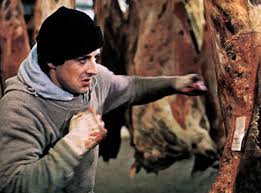
Here's a photo of Rocky punching some meat to block your way:
Rocky Balboa is one of my favorite characters of all time. The original Rocky came out in 1976, when I was 8 or 9 years old. I loved the story of the underdog who got a chance to make it big, and I especially loved that he had a goal -- just going the distance. And I loved that in the end, he got what he wanted -- he went the distance, and he won Adrian's heart. He's a true champion for a cancer patient.
Sometimes, when my wife has time to sneak in a nap, I'll wake her up by sitting next to her on the edge of the coach, and going through this scene:
And she's pretty good about doing Adrian's lines, even if she's still half asleep. She's good about going along with the goofy stuff that she knows will make me happy. Best of wives and women, as Alexander Hamilton would say about his Eliza.
I could go into a lot more of my love for the other Rocky movies, but let's talk about Creed.
In the movie, Rocky Balboa, now about 70 years old and grieving the death of his wife Adrian, when he agrees to become the trainer for Adonis Creed, the son of his friend and former opponent Apollo Creed.
Along the way, Rocky learns that he has cancer. This was pretty widely known even before the movie came out last year, but it was a surprise to me -- even more a surprise when the doctor told him he had Non-Hodgkn's Lymphoma!
I'm very interested in how NHL is portrayed in movies, TV shows, and in the news, because a lot of what people know about it is learned from those places. Misinformation is not good -- it creates fear (of how horrible a cancer diagnosis is) and ignorance (of what it means to be a cancer patient).
So I want to take a look at Rocky's cancer experience and see how ti holds up.
That's the kind of product placement I'd really like to see in a movie. An aging boxer sitting with his laptop, making informed choices about his cancer treatment.
So Creed does a decent job of handling cancer, though there could be a few changes without affecting the plot too much.
But more importantly, one of my movie heroes and I now have something in common. Besides being underdogs who won't give up the fight.
If I gave Nodes of Gold honors for fictional characters, Rocky Balboa would definitely have earned them.
I'll be back soon. I've gotta fly now. (Rocky joke.)
Here's a photo of Rocky punching some meat to block your way:
Rocky Balboa is one of my favorite characters of all time. The original Rocky came out in 1976, when I was 8 or 9 years old. I loved the story of the underdog who got a chance to make it big, and I especially loved that he had a goal -- just going the distance. And I loved that in the end, he got what he wanted -- he went the distance, and he won Adrian's heart. He's a true champion for a cancer patient.
Sometimes, when my wife has time to sneak in a nap, I'll wake her up by sitting next to her on the edge of the coach, and going through this scene:
And she's pretty good about doing Adrian's lines, even if she's still half asleep. She's good about going along with the goofy stuff that she knows will make me happy. Best of wives and women, as Alexander Hamilton would say about his Eliza.
I could go into a lot more of my love for the other Rocky movies, but let's talk about Creed.
In the movie, Rocky Balboa, now about 70 years old and grieving the death of his wife Adrian, when he agrees to become the trainer for Adonis Creed, the son of his friend and former opponent Apollo Creed.
Along the way, Rocky learns that he has cancer. This was pretty widely known even before the movie came out last year, but it was a surprise to me -- even more a surprise when the doctor told him he had Non-Hodgkn's Lymphoma!
I'm very interested in how NHL is portrayed in movies, TV shows, and in the news, because a lot of what people know about it is learned from those places. Misinformation is not good -- it creates fear (of how horrible a cancer diagnosis is) and ignorance (of what it means to be a cancer patient).
So I want to take a look at Rocky's cancer experience and see how ti holds up.
- First, Rocky gets the news: This was pretty realistic. Rocky was doing a pretty intense late night training session with Adonis when he got nauseous and fainted. He went for some tests, and then got a call from the doctor. And here's where it got very real -- he spoke calmly on the phone, and then in the next scene, he was in the doctor's office getting the diagnosis. Same thing happened to me, and it was the WORST way to get the news -- the doc said by phone, "Come on in and we'll talk about the test results," and then I had to wait four hours for the appointment. I asked what the news was while we were still on the phone, and she refused to tell me until I came in. Well, obviously it's bad news, right? That was not a good four hours. I understand wanting to be there for the patient, but I asked for the news -- tell me. I guess she wanted to be face-to-face so she could answer my questions. (Oh, wait -- she refused to answer my questions and told me I should ask the oncologist instead. But, hey -- she did offer my wife some valium. My wife calmly refused, pointing out that we had three kids to take care of, and this was not a good time to be high as a kite. Best of wives and women, I tell ya.)
- The diagnosis: The doctor told him he had "Large Cell Non-Hodgkin's Lymphoma." Now, as far as I can tell, there is no straight up "Large Cell NHL." There are two more specific types, though: Diffuse Large B Cell Lymphoma, and Anaplastic Large Cell Lymphoma. DLBCL is a B cell lymphoma, and ALCL is a T cell lymphoma. Both of them are treated with CHOP. I'm not sure which one of these was the one that Rocky was supposed to have, but I'm going with ALCL. Mr. T, who co-starred in Rocky III, is a T cell Lymphoma survivor (though I don't think he has ALCL). So I'm going to assume that Rocky's diagnosis is a loving tribute to Mr. T. Either that, or he just made up a type of NHL that sounded real.
- The treatment: The doctor describes the treatment -- surgery to remove the tumors in his lymph nodes, and then chemotherapy. Rocky refuses treatment. He'd already been through this with Adrian, and it didn't work for her. He eventually gives in and gets chemo. I think he skips the surgery, which is good, because I've never heard of removing tumors from lymph nodes. If anything, oncologists want the lymph nodes to stay, since lymphomas are systemic -- the cancer cells travel through the body, so removing a lymph node where they are gathering really won't do any good. And "removing the tumor from the lymph node" is kind of silly. Rocky is shown in a treatment room, with what looks like three IV bags. I assume they are Cytoxan, Adriamycin, and Vincristine (the C, H, O of CHOP)?
- The aftermath: I have to say, they did a pretty good job of making Rocky look tired and weak after he has the chemo. They show him getting sick, with Adonis taking care of him. I'd call that part pretty realistic, both in how the chemo affects Rocky, and in how Adonis acts as a loving caretaker. That was nice.
That's the kind of product placement I'd really like to see in a movie. An aging boxer sitting with his laptop, making informed choices about his cancer treatment.
So Creed does a decent job of handling cancer, though there could be a few changes without affecting the plot too much.
But more importantly, one of my movie heroes and I now have something in common. Besides being underdogs who won't give up the fight.
If I gave Nodes of Gold honors for fictional characters, Rocky Balboa would definitely have earned them.
I'll be back soon. I've gotta fly now. (Rocky joke.)
Thursday, May 12, 2016
Chemo-Free in Follicular lymphoma
A quick post to share a quick video:
Dr. Gilles Salles, a well-known lymphoma researcher from Lyon, France, gave a summary of strategies for going "chemo-free" in Follicular Lymphoma. He gave a presentation at the 2016 Annual Meeting of the British Society of Haematology (BSH) and International Society of Hematology (ISH), held in beautiful Glasgow, Scotland recently.
In the interview, Dr. Salles mentions some of the problems with traditional chemotherapy use in FL: mostly, it doesn't cure it, and it has some terrible side effects. Newer, more targeted treatments tend to have fewer side effects, and might give us hope for a cure.
Some of the newer, non-chemo treatments include Rituxan and other monoclonal antibodies, immune modulators, and kinase inhibitors. As we understand more about Follicular Lymphoma, we see that the micro-environment is important, and while chemo attacks the cells themselves (along with other healthy cells), more targeted treatments help deal with what surrounds those cells. Mess with the micro-environment and you mess with the cells. Combinations of different treatments seem especially valuable.
You can watch the short (2.5 minute) video here. Not really anything new, but I always like hearing a Lymphoma Rock Star talk about what he sees as the future of Follicular Lymphoma treatment.
Dr. Gilles Salles, a well-known lymphoma researcher from Lyon, France, gave a summary of strategies for going "chemo-free" in Follicular Lymphoma. He gave a presentation at the 2016 Annual Meeting of the British Society of Haematology (BSH) and International Society of Hematology (ISH), held in beautiful Glasgow, Scotland recently.
In the interview, Dr. Salles mentions some of the problems with traditional chemotherapy use in FL: mostly, it doesn't cure it, and it has some terrible side effects. Newer, more targeted treatments tend to have fewer side effects, and might give us hope for a cure.
Some of the newer, non-chemo treatments include Rituxan and other monoclonal antibodies, immune modulators, and kinase inhibitors. As we understand more about Follicular Lymphoma, we see that the micro-environment is important, and while chemo attacks the cells themselves (along with other healthy cells), more targeted treatments help deal with what surrounds those cells. Mess with the micro-environment and you mess with the cells. Combinations of different treatments seem especially valuable.
You can watch the short (2.5 minute) video here. Not really anything new, but I always like hearing a Lymphoma Rock Star talk about what he sees as the future of Follicular Lymphoma treatment.
Subscribe to:
Posts (Atom)